
To Issue 182
Citation: “Interview with Liz Proos and Ashley Hawson: DARE IDDS – A Long-Term Subcutaneously Implanted Drug Delivery Device”. ONdrugDelivery, Issue 182 (Jan 2026), pp 90–93.
Q What inspired the development of the DARE Intelligent Drug Delivery System (IDDS) and to what extent did patient needs shape the product vision?
LP The DARE IDDS is built on a legacy of innovation (Figure 1). The concept was originally developed out of Bob Langer and Michael Cima’s lab at the Massachusetts Institute of Technology (Cambridge, MA, US) and was spun out into a company by one of their graduate students, John Santini. The core concept was to develop a technology that could address patient needs around medication adherence and reduce the treatment burden by offering a smart device that could deliver therapies automatically from months to years. Since then, Daré has pioneered the concept through a first-in-human clinical trial to deliver parathyroid hormone for treating osteoporosis, and we are now developing the platform for broader use, initially targeting contraception.
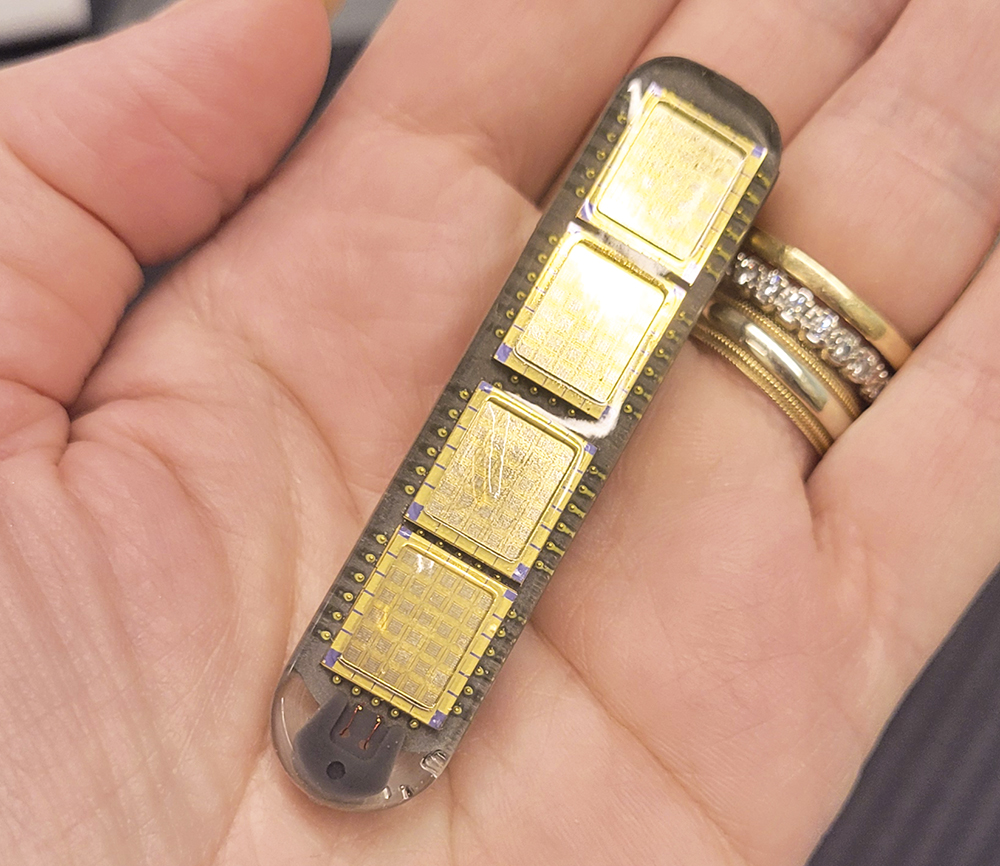
Figure 1: The DARE IDDS.
Q What were some of the biggest technical and regulatory challenges that your team faced in developing a ten-year implantable drug delivery system and how did you overcome them?
LP The major technical challenges were related to the overall design. How can we fit enough drug in a device small enough to be implanted safely? How can we make sure that we can communicate wirelessly and protect patients’ privacy? How can we ensure that the device remains sealed to protect the electronics and the drug product throughout the ultra-long period that it’s in the body? We addressed these challenges through creativity and collaboration, which is where our partnership with Cambridge Consultants really allowed us to take the concept to the next level.
AH One of the key things we had to figure out was how to ensure the hermetic sealing and biocompatibility for electronics that are going to be implanted for a full decade. There are also a lot of Class 3 regulatory requirements, software safety, cyber security issues and risk management concerns that need to be considered for this type of connected health product. Moreover, they typical cycles of iterative testing are quite challenging for an active implant that delivers a drug, as you are balancing parallel drug and device R&D activities while simultaneously navigating the preclinical and clinical trials with progressive levels of fidelity.
LP You would think that with such a novel concept we’d have to deal with a unique regulatory path, but in practice it wasn’t all that different from a standard combination product. Even though the device and the delivery mechanism are novel, the drug remains the primary mode of action and that’s what dictates the regulatory path. Because the IDDS’s architecture operates on the same principles as technologies that already exist in the implantable space, such as cardiac devices, neurostimulators and other devices that have gone through an approval process, the groundwork for how we need to approach it from a device perspective has already been laid, which makes things much easier.
Q What makes contraception a particularly impactful lead indication for Daré’s IDDS and how does it differ from existing long-acting contraceptive options?
LP While there are a lot of different options when it comes to contraception, years of user research has shown us that, in all cases, women feel that they have to compromise in some way with the current product offerings. Short-acting methods, such as taking a pill, might seem convenient and flexible, but there’s a burden with taking regular medication, including anxiety about forgetting. Alternatively, with the longer-acting methods, such as implants or intrauterine devices, these concerns can be avoided, but those are multi-year commitments. Not all women are willing to commit to that because they don’t know where life is taking them or what they might want to do over such a long term.
So we know that there’s an appetite for a more flexible solution. That’s whereDARE-LARC1 comes in – a user-controlled, long-acting, reversible contraceptive. We can store up to 10 years of contraceptive, but with the ability for the woman to turn it on and off by herself. The aim is to empower women to make family planning choices when it’s right for them, while continuously protecting them from pregnancy while the device is active. The device has the potential to be immensely impactful to women in rural areas and developing countries where access to reliable contraception can be challenging.
Q Can you elaborate on where the IDDS fits into Daré’s broader product pipeline?
LP Daré is focused on closing the gap in women’s health between promising science and real-world solutions. In addition to contraception, we have a broad pipeline of products that aim to address unmet needs in vaginal health, sexual health, menopause, infertility and a number other women’s health applications that have historically been pushed to the side. It’s exciting to be working on products that are going to be first-in-class in areas where there aren’t many options right now. We’re really looking to improve patient access and quality of life in these areas.
One of the unique aspects of the IDDS is that it can house multiple drugs in a single device because the drug compartments are all independent and can be individually and precisely delivered. This means that we’re able to synchronise dosing, whether it’s with other drugs or the patient. This is particularly exciting for infertility applications; it has the potential to significantly improve outcomes.
Another therapy area we’re looking at is oncology. Breast cancer patients will often have to undergo a series of monthly injections for up to five years after they have completed their treatment, which is extremely burdensome for someone who has already gone through an immensely stressful and painful treatment process. We could potentially replace those injections with a single implantable device, which would free women from having to travel to a clinic or a hospital to get their therapy.
Then there are cases like Parkinson’s disease where patients often will have “off episodes” in the morning, which are very debilitating. A device like ours could automatically deliver a dose overnight without the patient even having to be aware that it’s happening, which can significantly improve their quality of life and also reduce the burden on caregivers.
The last one I’ll mention specifically is metabolic diseases – there are a host of chronic conditions that require frequent injections that are a major burden for patients. A device like Daré’s IDDS, which can administer the drug automatically, could massively increase compliance, which is a huge issue for chronic diseases.
Q Can you expand on how Daré’s IDDS serves other stakeholders in the healthcare industry?
LP I attended several conferences last year, and the industry is still talking extensively about the need to transition care from the clinic to the home. A device such as the IDDS that can hold enough drug for months to years of therapy can facilitate that to a level most of the industry isn’t even considering yet. It has the potential to improve the patient experience to a whole new level.
When you improve patient access and the patient experience, you inherently improve the factors that clinicians, caregivers and the rest of the healthcare system are concerned about. If patients are getting their medication, then their condition is being managed. If you’re able to deliver drugs in a precise way that helps to reduce side effects, patients are less likely to seek extra care or be overly reliant on their caregivers. Conversely, if patients aren’t adherent, their symptoms return and they require more intense care, including hospitalisations. So the easier you can make it for patients to be adherent, the better it is for the whole healthcare system.
AH If you step back and look at the big picture, by reducing the number of adverse events patients experience and making their treatments much less burdensome, we’re addressing larger-scale socioeconomic needs with the potential to provide a widespread set of benefits. That includes sustainability benefits too – by virtue of moving care into patients’ homes, there are additional gains just from reducing travel.
Q What role do you see the connected health applications of the IDDS, such as remote monitoring and dosing control, playing in the future of healthcare?
LP I think that the IDDS has significant potential within the connected health arena, in particular due to its wireless communication functionality and its ability to seamlessly share and upload data. What’s special about the IDDS is that because it’s designed to operate either on-demand or on a pre-programmed schedule, the patient doesn’t need to do anything extra to take advantage of the IDDS’s connected features.
“CONNECTIVITY ALSO GIVES PATIENTS THE ABILITY TO QUERY THE DEVICE ITSELF AT ANY TIME, CHECKING IF IT’S DOSING PROPERLY OR JUST GETTING AN UPDATE ON THEIR HEALTH. THAT’S IN CONTRAST TO TRADITIONAL IMPLANTS, WHERE THERE’S NO ACTIVE WAY FOR PATIENTS TO GET FEEDBACK.”
Also, connectivity gives patients the ability to query the device itself at any time, checking if it’s dosing properly or just getting an update on their health. That’s in contrast to traditional implants, where there’s no active way for patients to get feedback. And patients need that feedback – they want confidence, they want to know that their medication is delivering, they want to know that their condition is being treated.
AH When I think about how the IDDS is positioned within the connected healthcare ecosystem, it’s really easy to add in extra functionality and sensors because we’ve already cracked those problems – and we’ve already designed the device to live within the body for 10 years. What that means is that the IDDS could enable a closed-loop system. If you link an IDDS to a monitoring system, it can accurately and precisely respond to a patient’s needs in real-time, before the patient even realises they need medication. It’s another aspect of this technology that has the potential to fundamentally change how we care for patients.
Q What has the collaboration with Cambridge Consultants enabled that wouldn’t have been possible otherwise?
LP The partnership has been absolutely critical to the development of the IDDS platform. Cambridge Consultants has such a deep expertise in creating these custom solutions, in solving the incredibly challenging engineering problems involved. If you think about what we originally presented to them, it was little more than a concept, a prototype and a list of things we wanted to achieve. They immediately embraced that and worked with us in a seamless collaboration. It feels like we are one team and we share the passion to bring innovation like this to patients.
AH It’s been an incredibly easy and rewarding partnership – one of those ones that happens naturally without the need for hard work. That doesn’t happen all the time and it’s a precious thing when it does. I think we’ve both recognised that and have nurtured it along the way.
Q What excites you most about the future of the DARE IDDS and what kinds of partners or collaborators are you hoping to engage next?
LP We’re very open to all types of organisations and all types of partnerships. We’re excited to be able to offer this technology to the world essentially. We’re keen to open our platform up and say we’ve spent many years working on this, we’ve solved the hard problems, we have a platform that is ready to now engage with. What we want to know is what are your drug delivery challenges? What are you trying to address for your patient populations? What is the potential value that IDDS can offer to the area you’re focused in?
While Daré is focused on women’s health, the IDDS platform could have extensive applications beyond our specific sector. That makes us really excited to engage with partners and stakeholders in areas beyond women’s health because it allows us to explore the potential of the IDDS across healthcare. Precision dosing, improving patient access, remote monitoring, sustainable care pathways – we’re addressing so many different aspects of real-world challenges that we want to see the technology adopted across diverse patient populations.
And, while our platform is novel and exciting, we recognise that it has some unique manufacturing requirements. So to facilitate future partnerships, we’ve invested in custom manufacturing capabilities – cleanrooms, manufacturing space – so that we’re ready to start making products across multiple potential applications.
AH Daré has been prudent in how it’s set itself up for enabling all future development that it’ll need for this. And, as you can probably tell from reading the rest of the interview, Daré is a wonderful organisation to work with. The technology is mature and its state of readiness are very good. The company is in an excellent state and fantastic to work with.